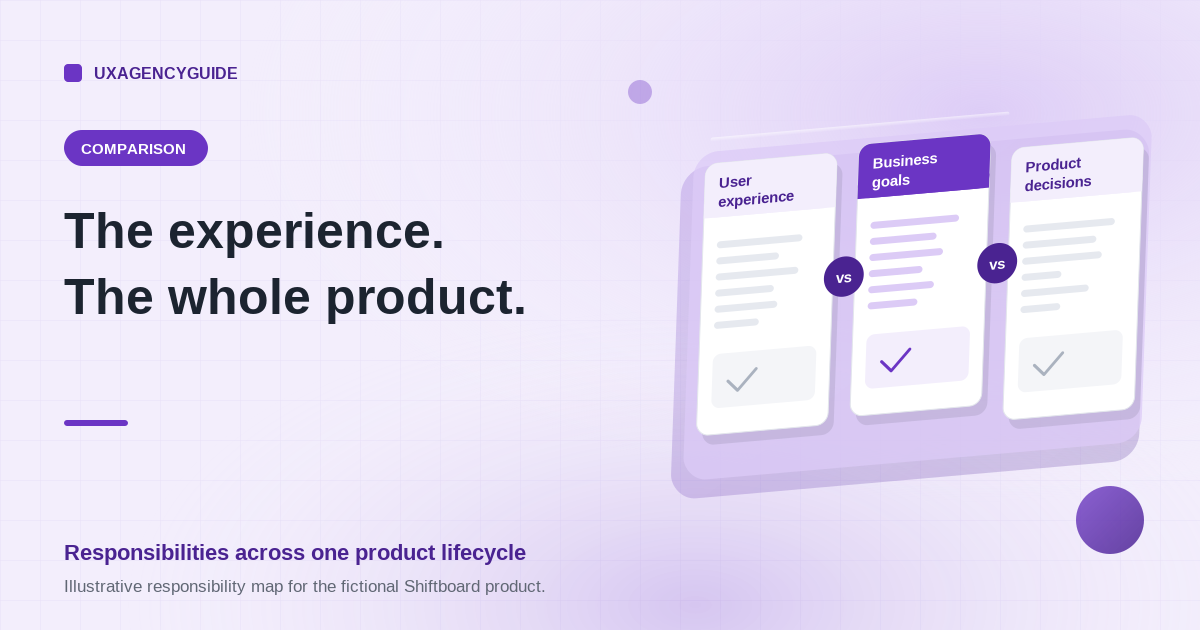
UX design and product design overlap heavily, and many companies use the terms interchangeably. Where they differ, it is in scope of responsibility. UX design focuses on users: understanding their needs, designing how tasks flow and testing whether the product works for them. Product design includes that work but takes on wider responsibility for the product itself, balancing user needs with business goals, technical constraints and what gets built when. A UX designer asks “does this work for people?” A product designer also asks “is this the right thing to build now, and how will we know it succeeded?”
This comparison clarifies the scope of each discipline, shows how responsibilities shift across one product’s lifecycle, and helps teams decide which expertise they are missing. It is about disciplines and responsibilities, not job titles or careers.
Define the comparison’s scope
There is no universal definition of either discipline, and that causes confusion when teams hire or commission work. A practical way to separate them is by what each is accountable for.
UX design is accountable for the user’s experience. Nielsen Norman Group’s definition of user experience describes UX as encompassing all aspects of a person’s interaction with a company, its services and its products. UX designers research needs, map journeys and flows, organize information, prototype and test.
Product design is accountable for the product’s design as a whole. Product designers usually do UX work, plus interface and visual design, and share responsibility for product decisions with product managers and engineers. They work with metrics, roadmaps and trade-offs between what users want, what the business needs and what can be built.
GOV.UK’s description of what each role does in a service team separates the product manager, user researcher, content designer, designer and developer. In that model, product decisions belong to the product manager and design decisions to designers. Many private-sector teams blend those responsibilities, and the product designer title often signals that blend.
Responsibilities and overlap
| UX design | Product design | |
|---|---|---|
| Main accountability | Users can understand and complete their tasks | The product’s design meets user and business goals |
| Research | Leads or uses it heavily | Uses it to make product decisions |
| Flows and structure | Leads | Leads or shares |
| Interface and visual design | Sometimes | Usually |
| Business metrics | Aware of them | Works with them directly |
| Roadmap and prioritization | Contributes evidence | Shares decisions with product management |
| Technical trade-offs | Considers them | Negotiates them with engineering |
| Typical setting | Specialist roles, larger teams, agencies | Product teams, startups, embedded roles |
The overlap is large. Both disciplines research, design flows and test. The difference is mostly about how far the role’s responsibility extends: from the user’s experience alone to the product’s overall design and outcomes.
Lifecycle example
Follow one illustrative product, Shiftboard, a fictional maintenance-scheduling tool, from discovery through iteration.
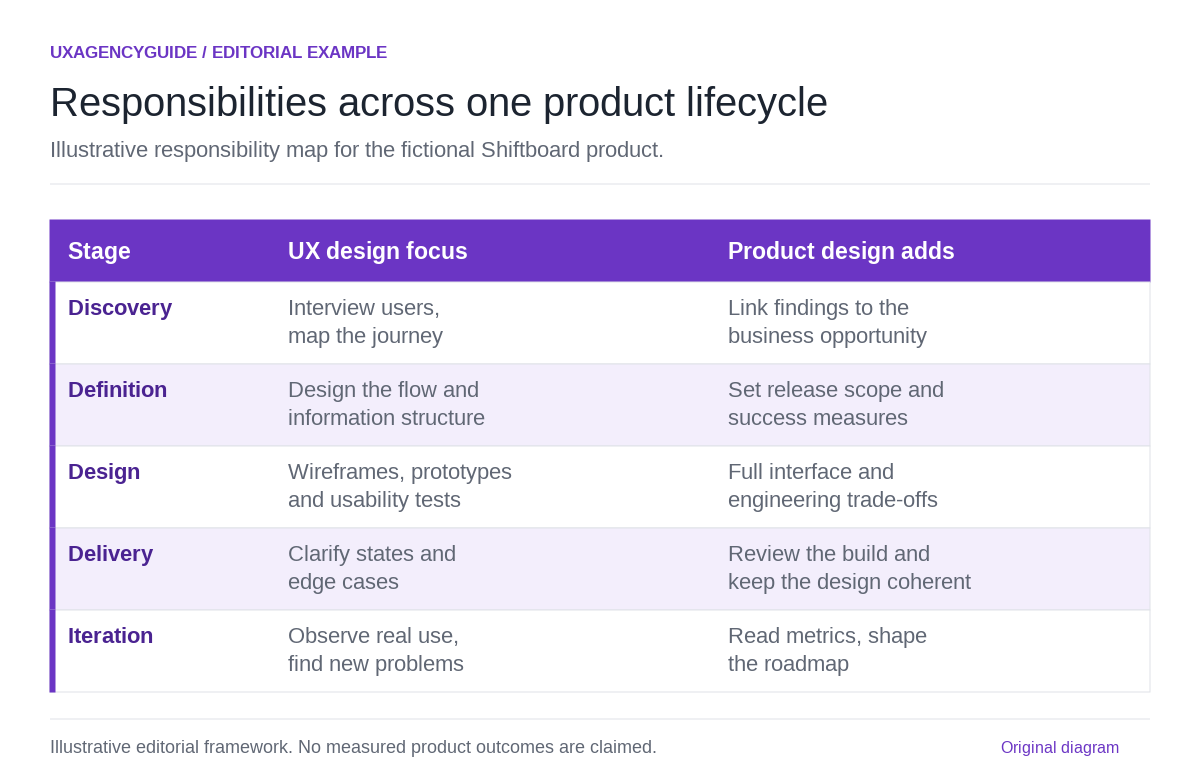
Discovery. UX focus: interview dispatchers and technicians, map the journey of rescheduling a late job, identify the most painful steps. Product design focus: connect those findings to the business opportunity and decide which problem to solve first. Shared: framing the problem.
Definition. UX focus: design the user flow and information architecture for rescheduling. Product design focus: define what is in the first release, what success looks like and how it will be measured, with the product manager and engineers. Shared: agreeing scope.
Design. UX focus: wireframes, prototypes and usability tests of the rescheduling flow. Product design focus: the full interface, consistency with the rest of the product and trade-offs where engineering constraints affect the design. Shared: iterating on the design.
Delivery. UX focus: clarify behavior, states and edge cases with engineers. Product design focus: review implementation, make decisions when constraints force changes and keep the design coherent. Shared: quality assurance.
Iteration. UX focus: observe real use, run follow-up research and identify new problems. Product design focus: read product metrics, decide what to improve next and feed that into the roadmap. Shared: deciding the next round of work.
In a small team, one product designer does all of this. In a larger organization, a UX researcher, a UX designer and a product designer may each lead different parts.
Deliverables and ownership
The deliverables overlap, but ownership differs.
Shared deliverables. Research findings, journey maps, user flows, wireframes, prototypes and usability test results are produced in both disciplines.
More often owned by product design. Final interface designs across the product, design system contributions, success metrics for design changes, design input into roadmaps and decisions about trade-offs during delivery.
More often owned by UX specialists. In-depth research programs, information architecture for large products, usability benchmarks and accessibility reviews.
Agencies describe their scope in different ways, which shows the range of operating models rather than one definition. ustwo’s Mavie case describes strategy, iOS design, privacy-first architecture and a design system for a wellness app co-developed with a physician founder, including product decisions such as deliberately avoiding streaks and performance tracking. That is product design in the broad sense: shaping what the product is, not only how it is used. In its RVO Health case, ustwo describes embedding product, delivery and engineering staff with the client.
Work & Co’s expertise page describes uniting hands-on product, design and technical talent, and its process page describes working from specific KPIs, rapid prototyping and continuous testing, with development starting at kickoff. That model ties design closely to product outcomes and engineering from the start.
Team configurations
How teams arrange these responsibilities varies with size and stage.
A single product designer. Common in startups. One person researches, designs flows and interfaces, and works with founders and engineers on what to build. Strong for speed and coherence, limited in depth and capacity. Our UX design for startups guide describes the work that person typically does before an MVP.
Product designers with a research specialist. As teams grow, a user researcher often joins to run deeper studies, while product designers focus on design and delivery.
UX and UI specialists coordinated by a design lead. Larger teams may separate UX, interaction, visual and content design, with a lead who owns the overall product design.
External product design support. Agencies often supply product design capacity. Cieden’s AI email assistant case describes one product designer working for eight weeks on the experience and workflows of an assistant that flags urgent messages, explains why it flagged them and drafts replies for people to approve. Its Lykon case describes one product designer joining the client’s product team, alongside its product manager, two front-end developers and QA, for 1.5 years. The first is a short, focused product design engagement; the second is an embedded role closer to an in-house product designer.
The right configuration depends on how much product decision-making the design role is expected to carry. Our comparison of agencies, freelancers and in-house teams covers how to choose between internal and external capacity.
How the distinction changes with company size
The difference between the two disciplines grows as organizations grow.
In an early startup, there is rarely a distinction at all. One designer, often called a product designer, researches users, designs flows and screens, works with the founders on what to build and helps engineers ship it. Separating UX and product design would mean hiring two people for one job.
In a growing company, the roles start to separate. A user researcher may join to run deeper studies. Product designers take responsibility for specific product areas and work closely with product managers and engineering leads on priorities and metrics. A design lead keeps the work coherent across teams.
In a large organization, specialist roles become common: UX researchers, interaction designers, content designers, visual designers, design system teams and product designers who coordinate them for each product area. Here the distinction matters most, because each role has different accountability and the handoffs between them need to be designed as carefully as the product.
Questions to ask candidates or agencies
- Which product decisions did you influence on a recent project, and how?
- How did you use research to change what was built, not only how it looked?
- How did you work with product management and engineering on trade-offs?
- Which metrics did you use to judge whether a design change worked?
- What did you hand over, and how was the design maintained afterwards?
Answers that describe decisions, trade-offs and outcomes point to product design experience. Answers focused on research, flows and usability point to strong UX design experience. Many good designers have both.
Choose the missing expertise
Most teams do not need to choose between product design and UX design. They need to identify what is missing.
- Do you understand your users well? If not, you need UX research, whether from a specialist or a product designer with strong research skills.
- Do people struggle to use the product? You need UX design: flows, structure and testing.
- Is the interface inconsistent or dated? You need interface and visual design, often within product design.
- Are design decisions disconnected from business goals and the roadmap? You need product design responsibility: someone who connects design to outcomes and trade-offs.
- Is there no one to own the design as a whole? You need a product design lead, in-house or embedded.
Write the role by responsibilities
When hiring or commissioning, describe the responsibilities rather than choosing a title. For example: “Research dispatchers’ scheduling work, design and test the rescheduling flow, produce the final interface using our component library, and work with the product manager to define success measures for the first release.” That description makes it clear that the role is product design with a strong UX component, and lets candidates and agencies show the right evidence.
Our UI vs. UX comparison covers the related distinction between interface design and the wider user experience.
When the titles do not matter
For most buyers and hiring managers, the title on a role or proposal matters far less than the responsibilities behind it. Two people called product designer can do very different work, and so can two people called UX designer. Ask what decisions the person or team will own, what evidence they will use and how they will work with product management and engineering. Those answers tell you which expertise you are actually getting.
Frequently asked questions
What is the difference between product design and UX design?
UX design focuses on the user’s experience: understanding needs, designing flows and structure, and testing whether people can use the product. Product design includes that work but takes wider responsibility for the product as a whole, balancing user needs with business goals, technical constraints and the roadmap. In many companies the terms overlap and the same person does both.
Is a product designer the same as a UX designer?
Often the titles describe similar work, and companies use them inconsistently. Generally, product designer roles carry more responsibility for product decisions, metrics and the interface as a whole, while UX designer roles emphasize research, flows and usability. Look at the responsibilities in a role or proposal rather than the title.
Does product design include visual design?
Usually, yes. Product designers commonly cover interface and visual design as well as UX, especially in smaller teams. Larger teams may separate visual or UI design into specialist roles while product designers coordinate the whole.
Which do I need for my startup?
Most early startups need someone who can do both: research and flows, interface design and close collaboration with founders and engineers on what to build. That combination is usually called product design. As the team grows, you may add research or UX specialists.
Sources & evidence
- The definition of user experience (UX)Checked 2026-11-20
- What each role does in a service teamChecked 2026-11-20
- Mavie x ustwoChecked 2026-11-20
- RVO Health x ustwoChecked 2026-11-20
- Expertise and practice areasChecked 2026-11-20
- ProcessChecked 2026-11-20
- LYKON health app design case studyChecked 2026-11-20
- Cieden: AI email assistantChecked 2026-11-23
Specific sources, useful examples and clear limitations make advice easier to assess.
Read the editorial policy