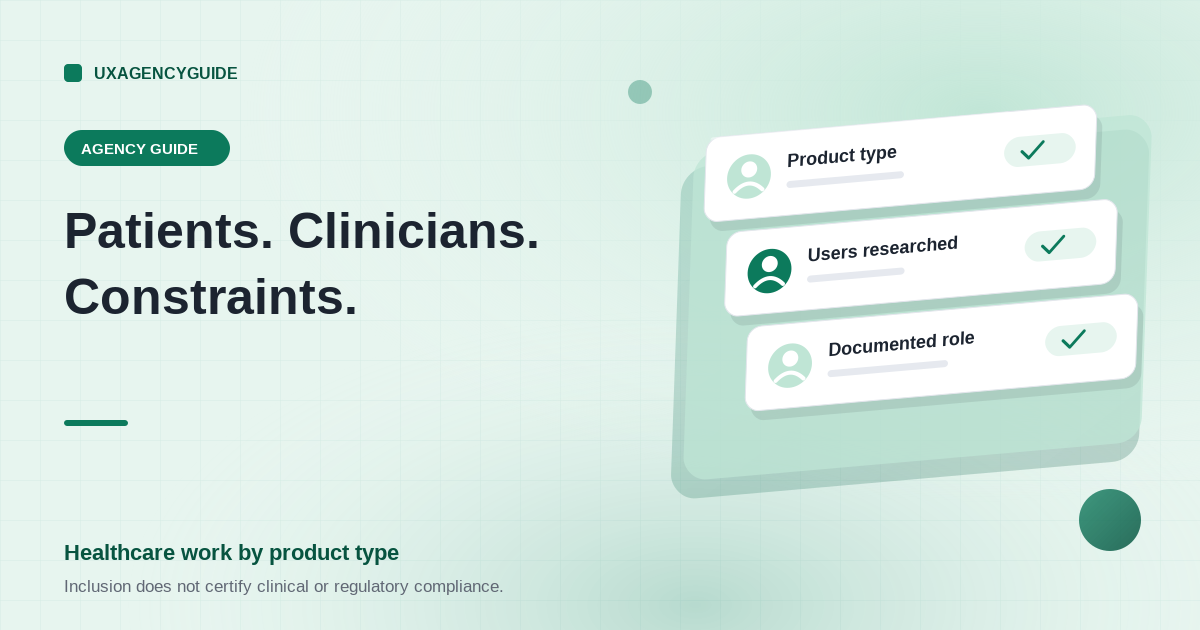
The right healthcare UX design agency is one with documented work on your type of health product, with your types of users, under constraints like yours. A telemedicine app for parents, a clinical coding tool for hospital staff, an FDA-regulated digital therapeutic and a consumer wellness app have little in common beyond the word health. Identify your product type first, because agency strengths divide along those lines.
This 2027 planning guide reviews seven agencies through healthcare work published on their own websites, checked in November 2026. We describe the product, the people researched and what the agency says it contributed. Inclusion here does not certify clinical, legal or regulatory compliance; those responsibilities stay with the product owner. This is a fit-based shortlist rather than a ranking, and no agency covered paid for inclusion, reviewed the text before publication or has a sponsorship, affiliate, paid-placement or ownership arrangement with the publication. See our disclosure for what this covers and when it was last checked.
Choose by healthcare product type
| Product type | Typical users | What design must handle | Agencies with matching evidence |
|---|---|---|---|
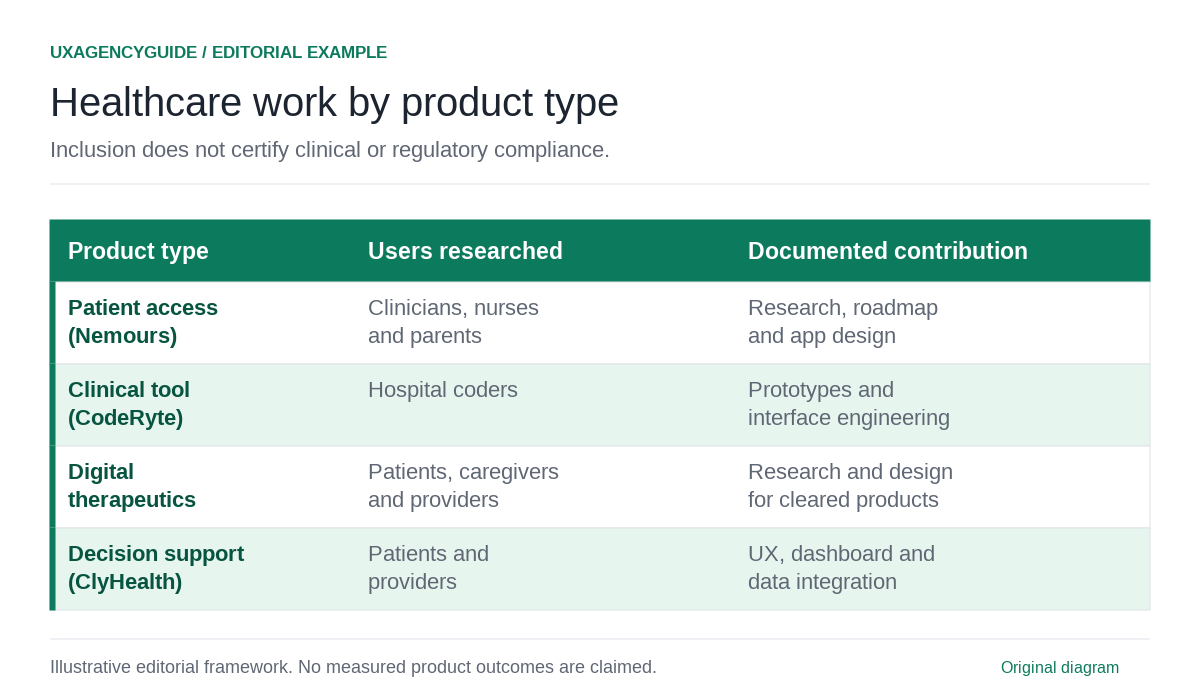
| Care delivery and patient access | Patients, parents, clinicians | Several audiences, records integration, trust | Think Company, GoInvo |
| Clinical and operational tools | Clinicians, coders, radiologists | Speed, accuracy, safety in high-pressure work | GoInvo, Fuzzy Math, Fuselab Creative |
| Digital therapeutics and SaMD | Patients under treatment, prescribers | Regulatory evidence, engagement over time | Guidea |
| Health data and decision support | Providers reviewing recommendations | Traceable reasoning, approval steps | Fuselab Creative |
| Wellness and behavior change | Consumers, coaches | Motivation without pressure, privacy | ustwo |
Products often straddle two types. A patient app that sends data into the clinical record is both a patient access product and part of a clinician’s workflow, so the design has to work on both sides. Our UX research methods guide explains how to choose research methods for products with several user groups, and our healthcare UX design guide covers the design decisions themselves.
Evaluation criteria
We assessed each agency’s published work against five questions.
- Which product type? Care delivery, clinical tool, digital therapeutic, decision support or wellness.
- Who was researched? Patients, caregivers, clinicians, administrators or a combination, and by what method.
- What constraints are described? Privacy (such as HIPAA), records integration (such as Epic or HL7/FHIR), regulatory clearance or clinical safety.
- What did the agency contribute? Research, strategy, interface design, design systems, engineering or data integration.
- What results are claimed and by whom? We report figures as the agency or client stated them. A case study is not a clinical outcome study.
Accessibility deserves its own check. Patient-facing products serve people with a wide range of abilities, often while unwell or stressed. The W3C Web Accessibility Initiative publishes the standards and guidance to discuss with any agency, and a healthcare agency should be able to describe how it applies them.
Agency evidence profiles
At a glance
The table compares the agencies in this guide on the same terms. The profiles below explain each project and what to check.
| Agency | Named project | Documented role | Suits this engagement | Published price or terms (20 Nov 2026) | Main limitation |
|---|---|---|---|---|---|
| GoInvo | CodeRyte | Staged prototypes; two designers and one engineer for 15 months | Clinical and operational tools | Design Diagnostic $50K to $90K; Product Launch $75K to $250K | Efficiency gain is the hospital’s estimate |
| Guidea | Digital health portfolio | Research and design for regulated products | Digital therapeutics and medical devices | Not published | Clearance counts cover the whole portfolio |
| Think Company | Nemours | 32 clinician and parent interviews; roadmap and telemedicine app | Patient access inside a health system | Vision Sprint about $50K; free half-day workshop | Rating is an app-store measure |
| Fuselab Creative | ClyHealth | Design plus HIPAA-compliant data integration | Decision support and health data | $100 to $150 per hour; engagements from $25,000 | Testing findings not published |
| Fuzzy Math | Clarix | Design team for a first medical device product | Specialist clinical tools | Not published; one-week starter engagements | Who wrote the code is not stated |
| ustwo | Mavie; RVO Health | Strategy, design and embedded engineering | Consumer health and behavior change | Not published; Discover from 8 weeks | Wellness work is not clinical evidence |
| Qubstudio | None public in healthcare | Data-heavy operational platforms | Only with private healthcare references | Not published | No healthcare case found |
| CorLab Tech | ePrescription; Referral MD | Engineering-led build | A separate build partner | MVP projects from $10,000 | Usage figures stated by CorLab |
Published terms are what each agency’s own website showed on 20 November 2026 (see our hiring benchmark); “not published” means we did not find a price, not that none exists. Roles and limitations are our reading of the cited project page.
GoInvo: clinical and enterprise health software
GoInvo’s homepage describes the studio as designing enterprise and healthcare software, including clinical, payer and patient software built within HIPAA and FDA constraints, and lists open-source health projects such as hGraph and Determinants of Health. Its CodeRyte case describes NLP-backed software for hospital medical coders, developed through an 8-week proof of concept, a 12-week working prototype and more than 15 prototypes, with daily feedback from a 12-hospital customer. The agency staffed it with two designers and one engineer over 15 months, and the page attributes a 200% coding efficiency increase to the hospital’s own conservative estimate.
GoInvo is a strong candidate for clinical and operational tools where staff productivity and data handling are central. The staged approach, with a stopping point after each phase, is a useful model for any health product with uncertain requirements.
Guidea: digital therapeutics and regulated products
Guidea’s digital health page describes research and design for software as a medical device and digital therapeutics, based on research with patients, caregivers and healthcare providers. It lists FDA-cleared digital therapeutics among its projects, including work it describes as research and design, and reports 22 FDA clearances and more than 40 clinical trials across its portfolio. Its guide to digital therapeutics design presents behavioral archetypes that the agency attributes to more than 1,000 hours of patient and provider research.
For a regulated product, this domain record is the main reason to shortlist Guidea. The figures are agency-reported and cover the whole portfolio, so ask which clearances its own research and design supported, and what usability evidence it produced for those submissions.
Think Company: patient access in a large health system
Think Company’s Nemours case describes 32 interviews with clinicians, nurses and parents across four locations of a large pediatric health system. That research shaped a four-year digital roadmap and a telemedicine app for parents, which began as a proof of concept for childhood asthma, expanded to heart conditions, diabetes and epilepsy, and syncs data into Epic. The agency says the app eventually replaced a patient portal that had low adoption, and reports a 4.9 rating from nearly eight thousand families.
This is strong evidence for care delivery products inside an established health system, where clinical workflows, records integration and patient trust all matter. Ask how the team selected the first pilot condition and how it worked with clinical staff during rollout.
Fuselab Creative: health data and clinician decision support
Fuselab Creative’s ClyHealth case describes a platform that uses genomic data, lab results and health history to generate personalized plans. The agency describes patient and provider interviews, a layered dashboard, HL7/FHIR interoperability and custom APIs for HIPAA-compliant data import, so this engagement included integration work beyond design. Supplement recommendations show their reasoning before a provider approves them, which keeps the clinician responsible for the decision.
Fuselab’s AI design practice page says healthcare accounts for more than half of its portfolio, and publishes rates of $100 to $150 per hour from $25,000. Investigate Fuselab for decision-support and health-data products, especially where AI recommendations need clinician review.
Fuzzy Math: clinical device and research software
Fuzzy Math’s Clarix case describes acting as the design team for the first version of a medical device startup’s product: a touchscreen kiosk for fast 3D scans inside the operating room and a desktop app for radiologists, informed by research with surgeons and radiologists. The work also covered branding and the first website. The page says design fed into development of the viewer but does not say who wrote the code.
Its pharmaceutical data analysis case adds clinical-trial analysis software. Investigate Fuzzy Math for clinical tools used in specialist settings, and for early-stage medical device companies that need product, brand and interface work together.
ustwo: wellness and behavior change
ustwo has two relevant cases. Mavie is a wellness app for mothers co-developed with a physician founder, for which ustwo describes strategy, iOS design, privacy-first architecture and a design system. The agency says the app deliberately avoids streaks, completion pressure and performance tracking. RVO Health’s Hope is an SMS coaching product for people stopping smoking, where ustwo embedded product, delivery and engineering staff and describes combining deterministic rules for compliance with generative conversation, while human coaches stay involved. The agency reports engagement of 57% against 22% for the earlier scripted program.
Investigate ustwo for consumer health and behavior-change products where tone, privacy and motivation matter as much as features. These are wellness and prevention products rather than regulated medical devices, so confirm regulatory experience separately if you need it.
Qubstudio: verify healthcare experience directly
Qubstudio has a healthcare service page, but the portfolio pages we reviewed did not include a project labeled healthcare, medical or wellness. Its published work shows strength in data-heavy operational platforms, such as financial risk and HR software. If you are considering Qubstudio for a health product, ask for healthcare case studies that may not be public and check references with health-sector clients before shortlisting.
Research and domain boundaries
Healthcare research needs more planning than most product research, and the agency’s experience here is one of the clearest differences between candidates.
Access to clinicians. Clinicians have little time. Agencies that work in hospitals, such as Think Company with Nemours, describe interviews across several locations, which requires sponsorship from inside the organization. Ask the agency what access it will need from you.
Patients and consent. Research with patients requires informed consent, careful handling of health information and sometimes ethics review. Ask how the agency recruits patients, stores recordings and removes identifying details.
Regulated evidence. For software regulated as a medical device, usability evaluation may form part of the regulatory submission. That changes how research is planned and documented. Guidea’s experience with cleared products is relevant here; most agencies will not have it.
Clinical judgment. Designers should not decide clinical content. The ClyHealth pattern, where recommendations show their reasoning and a provider approves them, keeps clinical responsibility with clinicians. Ask how an agency involves clinical advisers in design reviews.
Design versus implementation scope
The cases in this guide include design-only engagements, design with integration work and embedded teams. Healthcare makes the boundary especially important, because privacy, security and records integration are often where projects stall.
| Model | Example | Your team keeps | Key question |
|---|---|---|---|
| Design team handing to your developers | Fuzzy Math, Clarix | Engineering, security, regulatory submission | How will designs be reviewed during implementation? |
| Design with data integration | Fuselab Creative, ClyHealth | Product ownership, clinical decisions | Who is accountable for HIPAA-compliant data handling? |
| Embedded product and engineering team | ustwo, RVO Health | Clinical program and compliance | How will rules-based and generative behavior be governed? |
| Staged prototypes with a small build team | GoInvo, CodeRyte | Business case at each stage | When does the project stop if a stage fails? |
If you need a separate build partner, engineering firms such as CorLab Tech state that they build patient-facing MVPs aligned with HIPAA from the first commit. Treat that as a claim to verify through your own security review, and keep the design agency involved so that privacy requirements do not quietly change the experience late in the build.
CorLab’s named projects show what that engineering-led work looks like. Its ePrescription case describes a national system built with Moldova’s government in 11 months: doctors prescribe directly, pharmacists find patients by ID and can dispense only valid prescriptions, access uses digital signatures and functions are controlled by user role. CorLab reports usage of more than 1,400 providers and 1,688 pharmacies in its own voice. Its Referral MD case says an earlier design had too many screens and describes replacing it with one referral dashboard, hospital wait-time status and patient information within two clicks. Fuselab Creative also lists ReferralMD among its projects, so if that product matters to your decision, ask each supplier which part of the work it did.
Accessibility for patients and clinicians
Accessibility is a safety and reach issue in healthcare, not a finishing step. Patients may be older, unwell, medicated, anxious or using assistive technology. Clinicians may be working quickly, wearing gloves or reading screens across a room. The W3C Web Accessibility Initiative publishes the Web Content Accessibility Guidelines (WCAG), which most organizations use as their baseline for digital products.
Ask each agency how it applies those guidelines in practice: how it checks color contrast and text size, how forms and error messages work with screen readers, and how it reduces cognitive load in flows that people use while stressed, such as booking urgent care or entering symptoms. Ask whether research has included people with disabilities. An agency that treats accessibility as an audit at the end will struggle to fix structural problems found late.
Budget and timeline planning
Health products take longer than comparable consumer or SaaS work, mainly because of research access, privacy review and integration. The cases here show the range. GoInvo’s CodeRyte work moved through an 8-week proof of concept and a 12-week prototype within a 15-month engagement. Think Company’s Nemours research fed a four-year digital roadmap, with a single condition piloted first. Fuselab Creative publishes rates of $100 to $150 per hour from $25,000.
Plan the budget in stages, with a decision point after each. A sensible first stage covers research with each user group and a prototype of the highest-risk interaction, such as a clinician approving a recommendation or a patient entering health information. Include internal costs: clinical advisers’ time for research and review, privacy and security assessment, and integration work with records systems. Those often determine the timeline more than the design work itself.
Warning signs in healthcare agency pitches
Be cautious when an agency describes itself as compliant on your behalf. Design agencies can work within HIPAA or support a regulatory submission, but they do not make a product compliant. Be cautious, too, of portfolios that show attractive patient apps with no mention of clinicians, records or privacy, or of research plans that recruit general consumers for a clinical tool. Finally, look closely at outcome claims. A rating from families or an efficiency estimate from a hospital is useful context, but it is not a clinical outcome, and a careful agency will describe it that way.
Questions for reference checks
Reference calls are especially valuable in healthcare, because public case studies rarely describe research access, privacy handling or regulatory review in detail. Ask a past client:
- How did the agency get access to clinicians or patients, and how much of your staff’s time did it need?
- How were consent, recordings and health information handled during research?
- Did the designs change during implementation because of privacy, security or integration constraints, and how did the agency respond?
- If the product was regulated, what did the agency contribute to the usability evidence, and how was it documented?
- How did the agency involve your clinical advisers in design decisions?
- Would you hire the same team for your next health product, and for what kind of work?
The answers will tell you more than any portfolio about whether an agency can carry a health product through the constraints that make this sector different.
Keep the relationship close to the clinic
Whichever agency you choose, keep clinicians and patients involved after the research phase. Invite clinical staff to design reviews, test changes with patients before release and agree how feedback from the live product will reach the design team. Health products change as treatments, regulations and records systems change, so the best agency relationship is one that can return to the evidence regularly rather than one that ends at handoff.
Frequently asked questions
What makes healthcare UX different from other product design?
Healthcare products serve several groups at once, often patients, clinicians and administrators, and mistakes can affect safety. Research needs consent and clinical access, data is subject to privacy rules such as HIPAA in the United States, and some products are regulated as medical devices. Design decisions have to work within those constraints.
Does hiring an experienced healthcare agency make my product compliant?
No. An agency can design with regulatory and privacy requirements in mind and help produce usability evidence, but compliance remains the responsibility of the product owner and its regulatory, legal and clinical advisers. Ask which parts of a past evidence package the agency’s work actually supported.
Should a healthcare design agency also build the product?
It depends on your team. Some agencies in this guide include engineering or data integration, while others hand designs to the client’s developers. If you use a separate build partner, agree who owns privacy, security and integration decisions, and keep the design agency involved through implementation review.
How do I check a healthcare agency’s references?
Ask to speak with a client whose product type matches yours, such as a clinical tool or a patient app. Ask how the agency recruited patients or clinicians for research, how it handled privacy and consent, and how its designs held up during implementation and any regulatory review.
Sources & evidence
- GoInvo homepageChecked 2026-11-20
- Natural language processing software for hospital codingChecked 2026-11-20
- Digital health product designChecked 2026-11-20
- Expert guide to effective and engaging DTx designChecked 2026-11-20
- ClyHealth healthcare dashboard design and AI interfaceChecked 2026-11-20
- AI product design agency for regulated and enterprise AIChecked 2026-11-20
- Nemours Children’s HealthChecked 2026-11-20
- Clarix healthcare UX case studyChecked 2026-11-20
- Pharmaceutical data analysis case studyChecked 2026-11-20
- Mavie x ustwoChecked 2026-11-20
- RVO Health x ustwoChecked 2026-11-20
- Qubstudio workChecked 2026-11-20
- MVP development for startupsChecked 2026-11-20
- W3C Web Accessibility InitiativeChecked 2026-11-20
- CorLab Tech: ePrescription case studyChecked 2026-11-23
- CorLab Tech: Referral MD case studyChecked 2026-11-23
Specific sources, useful examples and clear limitations make advice easier to assess.
Read the editorial policy