Choose UX research methods by the question you need to answer, the decision it affects and the evidence you can responsibly collect. Interviews, observation, usability studies, surveys and experiments are useful for different purposes. No method becomes appropriate simply because it is quick, familiar or supported by a tool the team already owns.
Start with an uncertainty that could change the product plan. A founder asking whether a problem matters needs different evidence from a designer asking whether people understand a confirmation screen. This guide provides a decision framework and a worked research plan, with explicit limits on what each kind of finding can establish.
Start with the research question
A useful question names the people, the task and the uncertainty. “Understand our users” is an aspiration. “How do maintenance coordinators decide which unassigned request needs attention first?” is a researchable question. It points toward context, observed work and the information used in a decision.
Then name the product decision. Will the evidence change the ordering of a queue, the scope of a release or the wording of a permission explanation? If no one can identify a decision, the team may collect interesting material without knowing how to use it.
Separate business assumptions from interface questions
Whether a company will buy a product differs from whether a participant can use a prototype. A successful task does not establish willingness to pay. A positive interview does not prove that a workflow will fit into a busy working day. A survey preference does not establish actual behavior under operational constraints.
Write the assumption in a form that can be challenged. “Coordinators will save time” already implies an outcome. “Coordinators currently spend effort reconciling conflicting status information” is a claim that can be investigated. The next step may be observing the workflow, not testing a polished screen.
Identify the decision threshold
Before collecting evidence, discuss what would change the plan. The team might need to establish whether a critical task exists, whether a proposed label is misunderstood or whether an implemented change affects a defined measure. The threshold should match the method and consequences, rather than use a universal sample-size rule.
This planning conversation does not require pretending that every decision can be reduced to a number. It requires enough clarity to avoid interpreting any result as support for the preferred direction. Record competing explanations and the evidence that would help distinguish them.
Generative and evaluative evidence
Generative research explores a problem space and helps identify needs, constraints and opportunities. Evaluative research examines a proposed or existing solution. The distinction is useful for planning, although a study can produce both kinds of insight.
For a fictional maintenance product, observation might reveal that coordinators use a separate message thread to confirm property access. A prototype study might then examine whether an access-status field supports that task. The second study should not be treated as a substitute for learning why the workaround existed.
Interviews and contextual observation
An interview can explore a person’s account of their responsibilities, experiences and reasoning. Ask about specific recent situations rather than only opinions about an imagined future. A participant describing a difficult assignment may reveal dependencies that a feature-request question would miss.
Observation can show how work unfolds in its context, including interruptions, tools and informal coordination. It also has limits: the observer may see only a narrow period, and the participant may change behavior while being watched. Note those conditions instead of presenting one session as a complete view of the role.
GoInvo’s published health projects show how these methods combine in practice. For Flux Notes, a MITRE project, the studio describes shadowing four oncologists at Dana-Farber Cancer Institute during patient encounters, three interviews with subject-matter experts about how clinicians use record data while writing notes, and weekly feedback sessions with one to three physicians, two engineers and a patient advocate. Observation surfaced the constraint, that encounter time of about 15 minutes was being spent hunting for information. The design response was to capture structured data as the clinician types notes. The same page says user testing was still planned at the time of writing, which is a useful reminder that observation and expert feedback are not the same evidence as a usability test.
For Maya Healthcare’s nursing software, GoInvo describes working with back-office and field staff through intake, daily huddles, scheduling and visits, and then deciding to design scheduling and intake first. That is the method-to-decision link worth asking any research partner to show: which observation changed which priority.
Usability studies
A usability study examines how intended participants attempt realistic tasks with an interface or representation. The study needs appropriate recruitment, task wording and enough represented behavior. A prototype that excludes permission restrictions cannot establish that the full permission workflow is understandable.
Distinguish observation from inference in the notes. “The participant selected the administrator role” is an observation. “The person trusted the label” is an interpretation unless the study provides relevant evidence. Capture the action, relevant comments and conditions before forming a conclusion.
Product and operational evidence
Usage records, support issues and business data can help identify patterns. They need reliable definitions and an understanding of missing information. A low completion count may reflect intentional abandonment, a technical failure, an unavailable feature or an instrumentation problem.
Use operational evidence to inform the next question. Avoid treating every correlation as a causal explanation. A change in activity after a release may coincide with onboarding changes, a seasonal effect or a different customer mix. The appropriate conclusion depends on the study design and available controls.
Qualitative and quantitative methods
Qualitative evidence helps explore meaning, context and mechanisms. Quantitative evidence helps describe or compare measurements when the sampling and analysis support that use. These are complementary approaches, not a hierarchy in which a number automatically makes a conclusion stronger.
NN/g’s research-method selection framework distinguishes behavioral and attitudinal evidence alongside qualitative and quantitative approaches. We use those distinctions as a planning aid below. The original worked plan is our own editorial example, rather than a reproduction of a study from that source.
What people say and what people do
An interview captures a person’s account. A task observation captures behavior under the study conditions. Both can be useful. When the account and action differ, investigate the context rather than assuming one invalidates the other. The participant may be describing an unusual case, responding to social expectations or using a workaround that the task did not include.
A survey can reach more people, but unclear questions produce unclear data at a larger scale. Test whether respondents understand the categories and recall period. Do not assume that a convenient sample represents every buyer or user of the product.
Measurement needs a definition
Before collecting task success, specify what completion means, whether assistance is allowed and how partial completion is recorded. Before comparing time on task, decide when timing starts and ends. A precise-looking average is difficult to interpret when those rules differ across sessions.
Likewise, an experiment needs a suitable outcome, allocation approach and analysis plan. A small observational study should not be dressed up as an experiment because two designs were shown. If the team needs causal evidence, involve someone who can design and assess the appropriate study.
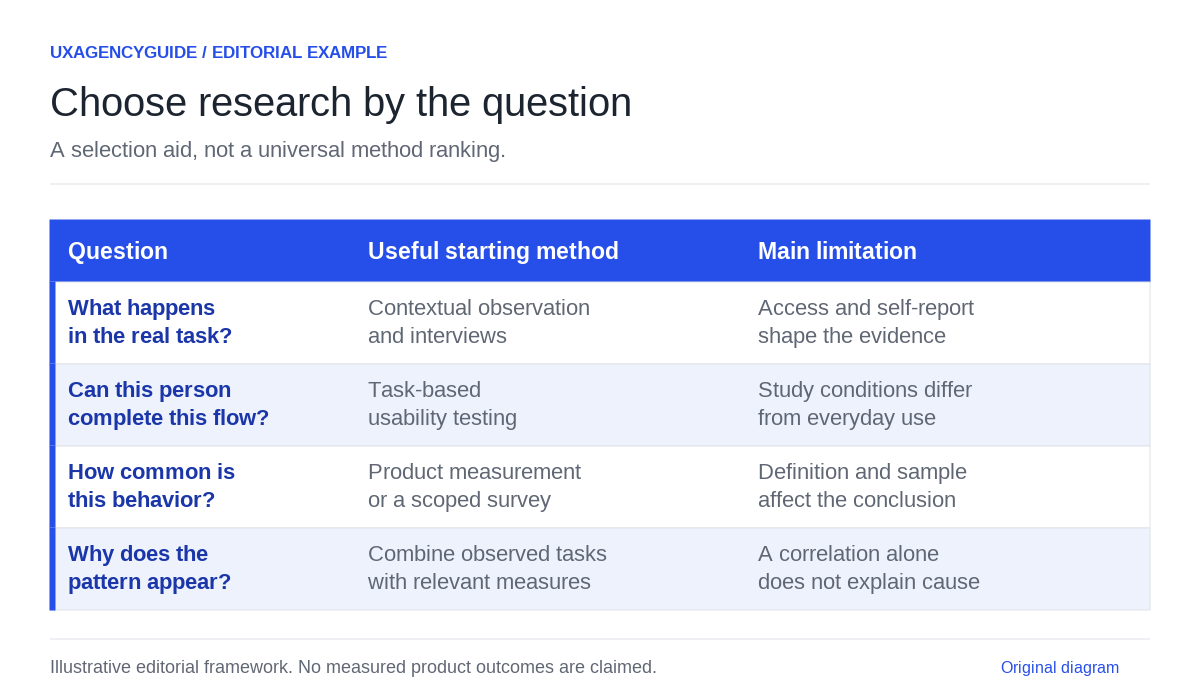
Method-selection grid
| Product question | Useful starting approach | Evidence to capture | Important limitation |
|---|---|---|---|
| How is the task handled today? | Contextual interview and observation | Steps, workarounds, constraints and responsibilities | Limited observed contexts may miss variation |
| Can people complete the proposed flow? | Task-based usability study | Actions, errors, assistance and interpretation | Prototype fidelity bounds the conclusion |
| What language or grouping makes sense? | Focused concept, content or structure research | Interpretations and grouping decisions | Preference alone does not establish task performance |
| How common is a defined issue? | Appropriate survey or reliable operational analysis | Defined responses or events with denominators | Sampling and instrumentation affect representativeness |
| Did a change cause an outcome? | Suitable controlled experiment where feasible | Predefined outcomes and conditions | Causal claims need a defensible design |
| What should be fixed first? | Combine inspection, task evidence and product context | Consequences, confidence and implementation dependencies | A priority score is still a decision aid |
The grid provides a starting point, not a compulsory sequence. Several methods may be useful for one question. The practical objective is to choose a proportionate evidence path and state what remains unknown afterward.
Recruitment and synthesis limits
Recruit people whose experience matches the decision. For a coordinator workflow, a generic panel participant may understand the interface yet lack the responsibilities that shape the real task. Write a screener around relevant experience, while avoiding unnecessary sensitive information.
Consider meaningful differences within the audience. A new coordinator and an experienced administrator may face different questions. A technician using a phone in the field may work under different conditions from an office manager. The sample plan should reflect the variation that matters to the decision, rather than merely fill available slots.
Consent and participant handling
Explain what will happen, what will be recorded and how the material will be used. Use appropriate consent and data-handling practices for the context. Avoid placing real credentials or sensitive customer records in a prototype just to make it feel realistic.
The logistics matter to evidence quality. A participant who cannot access the required device may be unable to complete a task for reasons unrelated to the interface. Record technical problems and assistance so those conditions do not disappear from the final interpretation.
Synthesis without overclaiming
Organize notes around observations and the question they inform. Preserve contradictory evidence and examples that do not fit the initial explanation. A theme should be traceable to the underlying material, not only to an attractive summary slide.
Do not translate a handful of qualitative observations into a population percentage. Describing which participants encountered an issue under the study conditions is different from estimating prevalence across all users. If prevalence matters, plan evidence that supports that inference.
AI-assisted transcription or summarization can help organize material, but review it against the source. An incorrect speaker attribution or omitted qualifier can change the meaning of a finding. Tool output remains something to inspect, not a replacement for research responsibility.
Practitioner context
Qubstudio’s Workforce Velocity case describes a combination of research, audit and product-design work in a specific workforce context. The useful lesson for commissioning is to ask how a research activity connects to an interface decision, rather than assuming that every discovery workshop produces the same evidence.
UX Studio’s Inquisita case provides a prototype-oriented example. Keep that output boundary intact: a prototype engagement does not establish that a production service was released or achieved a measured business outcome. Agency accounts remain attributed descriptions of their own work.
Aufait UX’s ID Fresh research case is a clear example of contextual methods. The agency lists participant observation on salespeople’s daily routes, contextual inquiry at distribution centers, factories and stores, workflow mapping and a role-based analysis of data requirements. Those methods suit an operational product where work happens away from a desk and paper records sit alongside software.
Guidea’s digital health practice describes research with patients, caregivers and healthcare providers for regulated health products, including digital therapeutics. Its guide to digital therapeutics design presents behavioral archetypes that the agency attributes to more than 1,000 hours of patient and provider research. In regulated contexts, method choice also depends on consent, clinical oversight and the evidence a product will later need, so a research plan should state those constraints at the start.
A worked research plan
The fictional Shiftboard team wants to know whether coordinators can invite a technician with the intended permission scope. The product decision is whether the proposed role explanation is clear enough to proceed to implementation, and what should change if it is not.
Define the task and participants
Recruit intended coordinators with relevant team-management responsibilities. Prepare a prototype containing role selection, realistic permission descriptions, validation, pending status and recovery. Use fictional addresses and records. State that the study evaluates the represented interaction, not email delivery or production security.
The task describes a situation: a technician needs access to assigned maintenance requests but should not change organization settings. Ask the participant to arrange that access. Avoid naming the role to choose or the control to press, because comprehension is part of the question.
Record the evidence
Capture the route taken, selected permission, questions, assistance and interpretation of the resulting status. Ask follow-up questions after observing the action so the explanation does not accidentally coach the participant. Record where prototype limitations interrupt the task.
The analysis should distinguish a misunderstood label from a missing rule. If the product team itself cannot define the difference between roles, the next action may be a policy decision rather than a wording revision. Research can reveal that ambiguity without solving it automatically.
Make the decision and preserve the limits
Use the findings to revise the explanation, role model or task sequence as appropriate. Recheck consequential changes. Document which participants and conditions were included and which questions remain open. Do not claim that the study proves general market demand or every aspect of access security.
The UX audit guide can help inspect the flow before sessions. The testing-tools comparison helps separate platform selection from recruitment and research design. The artifact comparison helps choose the representation needed for the question.
Close the loop with the product team
Assign each accepted finding an owner and a next action. Keep the underlying observation linked to that decision so implementation discussions do not turn into disconnected opinions. If the team chooses not to act, record why and what evidence would cause a review.
Research earns its place when it improves a decision. A well-scoped study can do that without a large report, a broad claim or a fashionable tool. The essential work is connecting the question, the evidence and the action while preserving the limits that make the conclusion trustworthy.
Choose a proportionate next study
After synthesis, identify the uncertainty that remains most consequential. The next step does not have to repeat the same method. An interview may reveal an unfamiliar task that needs observation. An observation may reveal a terminology issue that needs a focused prototype. A prototype study may reveal that the product team has not agreed on the rule it is trying to explain.
Carry forward the actual finding rather than a broad statement that “more research is needed.” Write the new question, why it matters and what evidence would change the decision. This keeps the program bounded and makes it easier to recognize when the team knows enough to proceed responsibly.
Also review whether another study would change the choice at all. If two options have equivalent consequences and the remaining uncertainty is minor, a reversible implementation may be proportionate. Research planning includes deciding where evidence is worth collecting, not treating every unanswered question as an automatic reason to delay the product.
When the decision is consequential or difficult to reverse, document why the available evidence is sufficient or why another check is necessary. That record helps a future team understand the trade-off without assuming that the original researchers had certainty they never claimed. It also makes the next study easier to scope if conditions change.
Frequently asked questions
Which UX research method should come first?
Start with the unresolved product question. Contextual research, task observation, measurement and experimentation support different decisions; a familiar tool should not determine the method by default.
Is qualitative research weaker than quantitative research?
They answer different kinds of questions. The usefulness of either depends on the design, evidence quality and the inference being made, rather than whether the result contains a number.
Does a successful prototype task prove demand?
No. It provides evidence about the represented task under the study conditions. Market demand, payment and continued use require their own investigation.
Sources & evidence
- NN/g’s research-method selection frameworkChecked 2026-11-19
- Workforce Velocity HRTech Platform RedesignChecked 2026-11-19
- Building confidence in AI for high-stakes legal workChecked 2026-11-19
- UX research for ID Fresh’s sales systemChecked 2026-11-20
- Digital health product designChecked 2026-11-20
- Expert guide to effective and engaging DTx designChecked 2026-11-20
- GoInvo: Flux Notes (MITRE)Checked 2026-11-23
- GoInvo: Care Over Clicks (Maya Healthcare)Checked 2026-11-23
Specific sources, useful examples and clear limitations make advice easier to assess.
Read the editorial policy