Choose moderated usability testing when you need to understand why people struggle, and unmoderated testing when you need to see how often a specific problem happens, across more people, quickly. A moderated session has a facilitator who can ask questions, clarify and follow the participant’s reasoning. An unmoderated session has no facilitator; participants complete tasks on their own while a platform records what they do. The question you need to answer decides which fits, and many studies use both.
This comparison goes deeper than the summary in our usability testing methods guide. It compares researcher involvement, participant and task constraints, and evidence limits, and shows one research question adapted into a moderated plan and an unmoderated plan. The examples use a fictional scheduling product, Shiftboard, and are illustrative.
Define the study decision
Start with the decision the study will inform, not the method. Three questions point clearly to one approach or the other.
Do you need to know why? If the team does not yet understand what goes wrong or why, a facilitator who can ask follow-up questions is valuable. Moderated testing explains behavior.
Do you need to know how many? If you already understand a problem and need to know how widespread it is, or which of two designs performs better on a defined task, more participants matter more than depth. Unmoderated testing scales.
How complex is the task? Tasks that need context, explanation, specialist knowledge or recovery from errors are hard to run without a facilitator. Short, self-contained tasks with a clear end work well unmoderated.
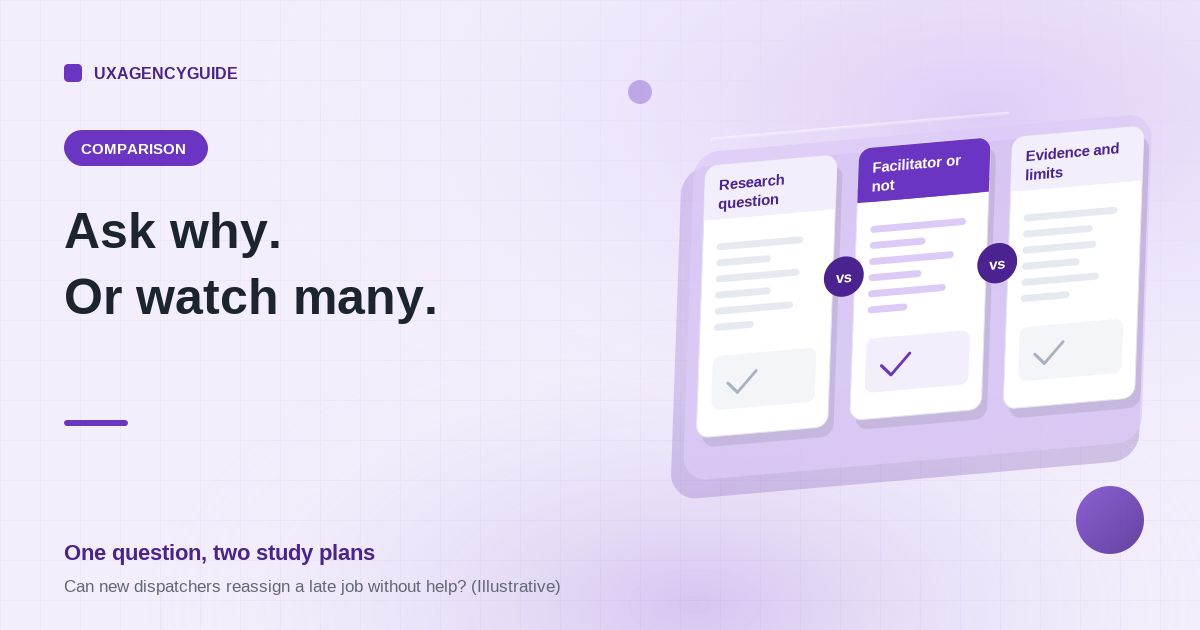
For Shiftboard, the team’s question is: “Can new dispatchers reassign a late job to another technician without help?” That question can be studied either way, and the two plans below show what each produces.
Compare researcher involvement
| Moderated | Unmoderated | |
|---|---|---|
| Facilitator present | Yes, live, in person or remote | No |
| Follow-up questions | Yes, during and after tasks | Only pre-written questions |
| Participants per day | Limited by researcher time | Many, in parallel |
| Researcher time per participant | High | Low during sessions, moderate for review |
| Handles confusion or errors | Facilitator can clarify or redirect | Participant may give up or guess |
| Best for | Understanding problems, complex tasks, specialists | Measuring defined tasks, comparing options, broad reach |
| Main risk | Facilitator influence on behavior | Misread tasks and low-quality sessions |
What the facilitator adds
A facilitator can notice hesitation and ask about it, rephrase a task that was misunderstood, help a participant recover from a technical problem and explore an unexpected path. GOV.UK’s guidance on moderated usability testing suggests sessions of 30 to 60 minutes and no more than six one-hour sessions a day, which reflects how demanding facilitation is.
The facilitator can also distort results. Nielsen Norman Group’s article on thinking aloud notes that facilitator prompts can bias participants’ behavior. Good facilitators stay quiet during tasks and use neutral prompts such as “What are you thinking?” rather than questions that suggest an answer.
What removing the facilitator changes
Nielsen Norman Group’s overview of tools for unmoderated testing describes unmoderated testing as having no facilitator, with participants completing tasks on their own and the platform recording their screen and voice. Without a facilitator, every instruction must be clear in writing, every question must be written in advance and there is no chance to recover a session that goes wrong. In exchange, many sessions can run at once, at times that suit participants.
Participant and task constraints
Participants
Specialists and hard-to-reach people. Clinicians, engineers, senior managers and people with specific conditions are hard to recruit and often expensive. Each session is valuable, so a facilitator who can make the most of it is usually worth the cost. In regulated domains, research also needs careful consent and data handling. Agencies that work in health, such as Guidea, which describes research with patients, caregivers and providers, typically plan those studies around facilitated sessions.
Broad audiences. For consumer products and general tasks, recruitment panels can supply many participants quickly. UX Studio’s research services page describes partnering with third-party panels for recruitment and lists methods such as five-second, first-click and navigation tests, which are often run unmoderated.
Accessibility needs. Participants using assistive technology may need setup support or adjustments. Moderated sessions handle this more reliably, and including these participants is important whichever method you use.
Tasks
Unmoderated tasks need to be short, unambiguous and self-contained, with a clear way for participants to know they have finished. Moderated tasks can be longer and more open, because the facilitator can clarify.
Remote considerations. Both methods can run remotely. Nielsen Norman Group’s article on remote usability tests prefers in-person testing where possible but is clear that remote testing is far better than not testing. It notes that unmoderated tests are best for a few specific elements rather than an overall review, and recommends recruiting extra participants for remote studies because no-show rates are higher.
Matched study plans
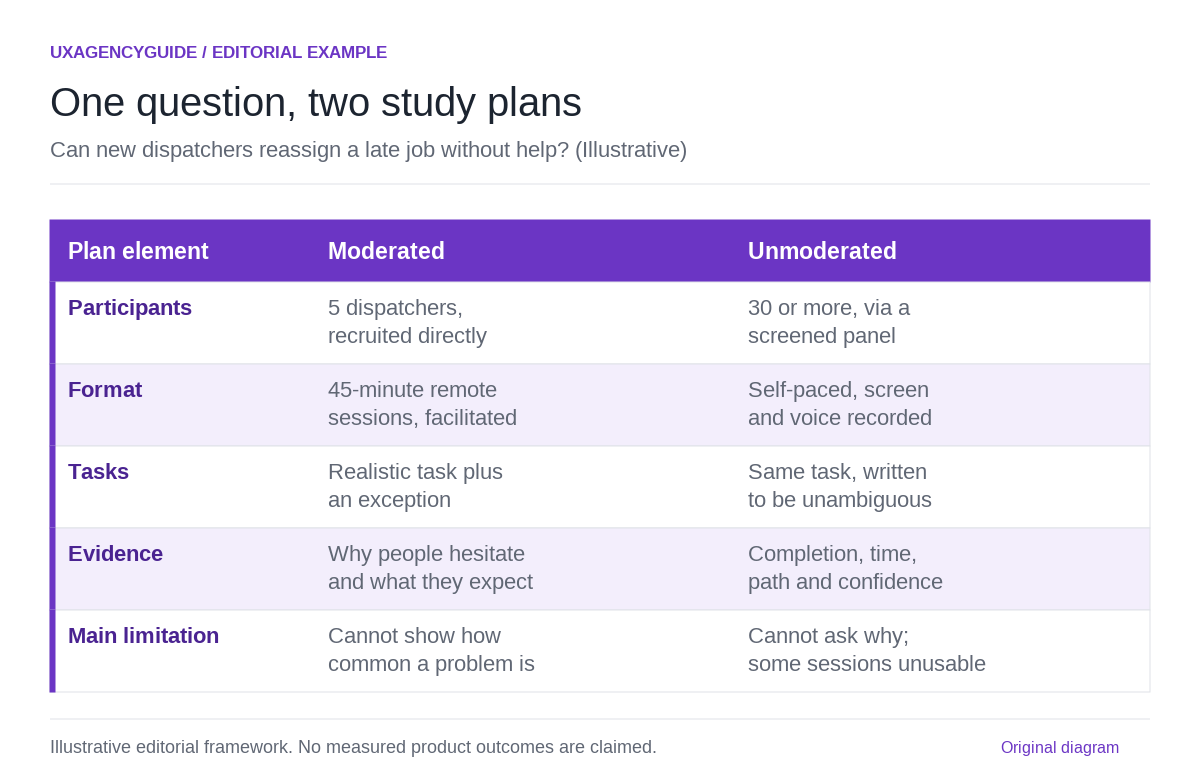
The same research question produces two different plans.
Plan A: moderated
- Participants: five dispatchers who schedule field work, recruited for experience with scheduling but not with Shiftboard. Nielsen Norman Group’s guidance on testing with five users suggests that a round of this size usually shows the main problems.
- Format: 45-minute remote video sessions with screen sharing, one facilitator and one observer.
- Tasks: one realistic reassignment task (“A job at the north site is running two hours late. Make sure the afternoon is still covered.”), one task involving a technician who has not confirmed and one exploratory question about how they would normally handle the situation.
- Evidence captured: task success, where participants hesitated, what they expected to happen, their explanations and their own workarounds.
- Strength: explains why problems happen and reveals problems the team did not anticipate.
- Limitation: five people cannot show how common a problem is, and the facilitator’s presence can change behavior.
Plan B: unmoderated
- Participants: 30 dispatchers or people in similar scheduling roles, recruited through a panel with screening questions, plus a few extra to allow for low-quality sessions.
- Format: tasks completed on the participant’s own schedule through a testing platform that records screen and voice.
- Tasks: the same reassignment task, written with care so it cannot be misunderstood, followed by a short question asking how confident they were and an open question about anything confusing.
- Evidence captured: completion rate, time on task, the path taken, confidence ratings and short spoken or written comments.
- Strength: shows how widespread a problem is and allows comparison between design options.
- Limitation: cannot ask why, misunderstood tasks look like failures and some sessions will be unusable.
What each plan would tell the team
If the moderated study shows that dispatchers miss the unconfirmed-technician warning because they expect it on the schedule rather than in a separate panel, the team learns what to change. If the unmoderated study then shows that two-thirds of participants complete the redesigned task, the team learns whether the change helped at scale. Together, the two plans answer both “why” and “how many”.
Analysis and evidence limitations
Moderated analysis
Moderated sessions produce rich notes and recordings. Analysis means grouping observations into problems, judging severity and linking each problem to evidence. The main limitation is sample size: findings show what can go wrong and why, not how often. Report them as problems observed, not percentages.
Unmoderated analysis
Unmoderated studies produce more data and more noise. Review a sample of recordings, not only the metrics, because a low completion rate may come from a confusing task rather than a confusing design. Remove sessions where participants clearly did not engage, and report how many were excluded and why. Percentages from unmoderated studies are more meaningful than from five moderated sessions, but they still depend on who was recruited and how the task was written.
Limits common to both
Both methods take place outside real work. Participants know they are being studied, use test data and are not under the pressures of a real day. Neither replaces observing the product in use. Record the limits of each study alongside its findings, so decisions are made with the right level of confidence.
Budget and timeline
The two approaches spend money and time in different places. Moderated studies spend most of their budget on researcher time: planning, running each session, taking notes and analyzing. A round of five 45-minute sessions might take a few days of researcher time in total, plus participant incentives. Recruitment can take longer than the sessions themselves for specialist audiences.
Unmoderated studies spend more on the platform and on participants, and less on running sessions. Planning is just as important, and often more, because every instruction must work without help. Analysis takes real time too: watching a sample of recordings, removing poor sessions and interpreting the metrics. Budget for a pilot with two or three participants before the full launch; fixing a confusing task after 30 people have attempted it wastes most of the study.
For either approach, include the time needed to turn findings into decisions with the product team. A study that produces a report nobody acts on has cost money without changing the product.
Choose or combine approaches
| If you need to | Choose |
|---|---|
| Understand why people struggle with a new design | Moderated |
| Test with specialists or in sensitive contexts | Moderated |
| Check whether a known problem is widespread | Unmoderated |
| Compare two designs on a defined task | Unmoderated |
| Test early prototypes that need explanation | Moderated |
| Get quick feedback on first impressions or navigation | Unmoderated |
| Both understand a problem and measure a fix | Moderated, then unmoderated |
Combining the two
A practical pattern for many product teams:
- Run a small moderated round to find the main problems and understand them.
- Fix the design based on what you learned.
- Pilot the unmoderated tasks with two or three people to check the instructions are clear.
- Run an unmoderated study with more participants to confirm the fix works at scale.
- Return to moderated sessions when new or unexpected problems appear.
Practical checks before you start
- Write the research question and the decision it will inform.
- Decide which evidence you need: explanation, frequency or both.
- Check whether your participants can be recruited through a panel or need direct recruitment.
- For unmoderated studies, pilot the tasks before launch.
- Decide if and how sessions will be recorded, and how recordings and personal data will be stored; GOV.UK’s guidance includes both as planning steps.
- Budget researcher time for analysis, not only for running sessions.
If you are choosing software to run either kind of study, our usability testing tools guide compares platforms by study type and cost. For research questions beyond usability, such as understanding needs before designing, our UX research methods guide covers interviews, observation and other approaches.
Frequently asked questions
What is the difference between moderated and unmoderated usability testing?
In moderated testing, a facilitator runs each session live, in person or remotely, gives tasks and can ask follow-up questions. In unmoderated testing, participants complete tasks on their own, usually through a testing platform that records their screen and voice, with no facilitator present. Moderated testing explains behavior; unmoderated testing scales it.
Is unmoderated testing cheaper?
Per participant, usually yes, because no researcher needs to attend each session. But it is not free: you still need to plan carefully, recruit the right people, pay platform and incentive costs and spend time reviewing recordings. Poorly planned unmoderated studies can waste more than they save.
Can I use both in the same project?
Yes, and many teams do. A common pattern is to run a few moderated sessions to understand problems and refine tasks, then an unmoderated study with more participants to check how widespread a problem is or to compare design options.
Which is better for complex or specialist products?
Moderated testing is usually better when tasks are complex, participants are specialists, the product needs explanation or the setting involves sensitive information. A facilitator can clarify, probe and handle problems that would end an unmoderated session.
Sources & evidence
- Remote usability tests: moderated and unmoderatedChecked 2026-11-20
- Tools for unmoderated usability testingChecked 2026-11-20
- Thinking aloud: the #1 usability toolChecked 2026-11-20
- Why you only need to test with 5 usersChecked 2026-11-20
- Using moderated usability testingChecked 2026-11-20
- UX research services for B2B SaaS teamsChecked 2026-11-20
- Digital health product designChecked 2026-11-20
Specific sources, useful examples and clear limitations make advice easier to assess.
Read the editorial policy