UX usually refers to people’s experience of using a particular product, such as an app, a website or a piece of software. CX refers to the customer’s whole relationship with a company over time, across every channel: marketing, buying, onboarding, using the product, getting support, paying bills and eventually leaving. UX is part of CX. A product can have excellent UX and still sit inside a poor customer experience, because the customer judges the whole journey, not one screen.
This comparison defines the two terms in context, maps one customer goal across product and service touchpoints, and explains how ownership and measurement differ. It shows where product design can improve customer experience, and where it cannot on its own. For the mapping method itself, see our user flow vs. user journey comparison.
Define UX and CX in context
The terms are used inconsistently, so it helps to see how authoritative sources frame them.
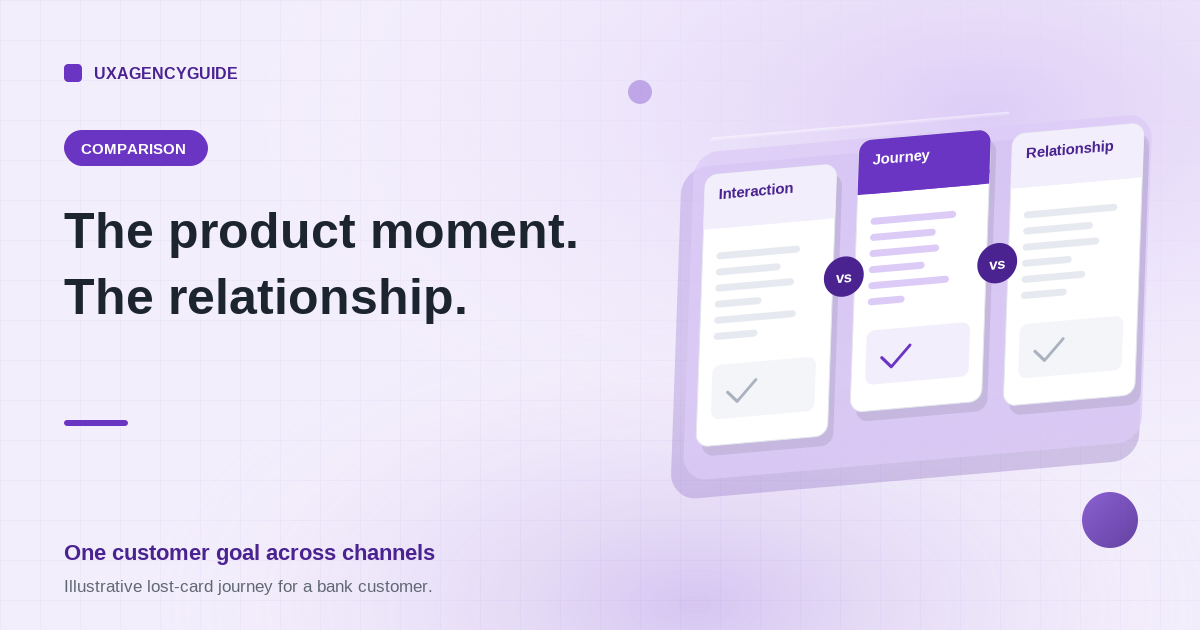
Nielsen Norman Group’s definition of user experience is broad: it describes UX as encompassing all aspects of a person’s interaction with a company, its services and its products. In that sense, UX already includes much of what others call CX. Nielsen Norman Group’s article on UX versus CX describes CX as a term commonly used for UX over long periods of time, and distinguishes three levels of experience: individual interactions, journeys made of several interactions, and the overall relationship. It concludes that which term a team uses matters less than using the terms consistently.
In practice, most organizations use the words this way:
| UX | CX | |
|---|---|---|
| Typical scope | A product or service, such as an app or website | The whole relationship with the company |
| Time frame | Minutes to days | Months to years |
| Channels | Usually one or a few digital channels | All channels, digital and human |
| Typical owners | Product and design teams | Shared across product, support, marketing, operations and sales |
| Typical measures | Task success, errors, usability, product analytics | Satisfaction, likelihood to recommend, retention, complaints |
| Level (NN/g) | Interaction and journey | Journey and relationship |
The most useful takeaway is the levels. A single interaction, such as freezing a card in an app, is UX at its most focused. A journey, such as replacing a lost card, spans several interactions and channels. The relationship, such as whether the customer stays with the bank, builds from many journeys over time.
Map one customer goal
Consider an illustrative banking customer who loses a debit card. The goal is simple: stop anyone using the card and get a working replacement. The journey crosses several channels and teams.
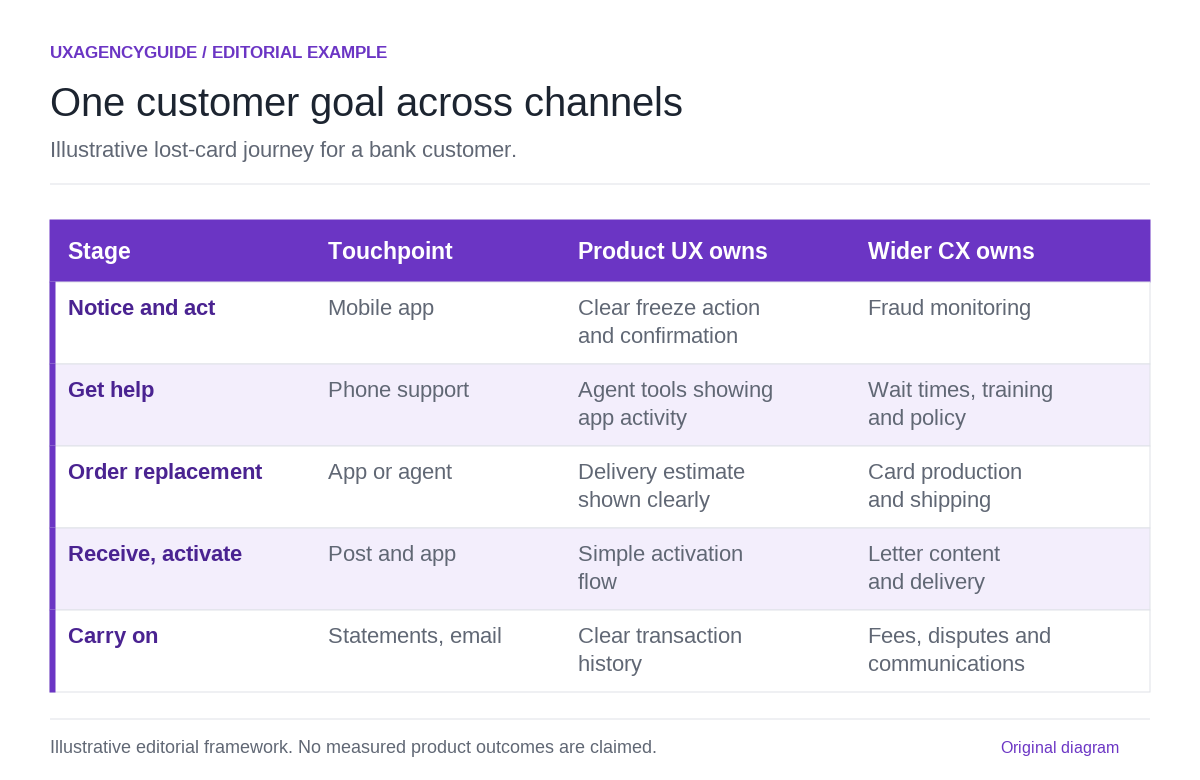
- Notice and act. The customer realizes the card is missing and opens the app to freeze it. This is product UX: the action should be easy to find and should confirm clearly that the card is frozen.
- Get help. The customer is unsure whether to cancel the card or wait, and calls the support line. This is service experience: wait times, the agent’s knowledge and whether the agent can see what the customer already did in the app.
- Order a replacement. The customer orders a new card, in the app or through the agent. Product UX and operations meet here: the app should show the delivery estimate, and operations must meet it.
- Receive and activate. The new card arrives by post with a letter. The customer activates it in the app. Delivery, the letter and the activation flow all shape the experience.
- Carry on. The customer updates the card on subscriptions and notices whether any fees or disputed charges are explained. Communications and policy shape this stage.
A journey like this shows why a well-designed app is necessary but not sufficient. If the app makes freezing the card effortless but the support agent cannot see that the card is frozen, or the replacement takes two weeks, or the letter is confusing, the customer’s experience is poor.
Fuzzy Math’s masterclass on journey mapping suggests analyzing journey maps for unmet expectations, friction points and time-intensive effort, and distinguishes positive time customers value from negative time spent waiting or repeating themselves. In this journey, most of the negative time is outside the app.
Product and service touchpoints
Each stage involves touchpoints that different teams own.
Product touchpoints. The app or website: the freeze action, the replacement order, the delivery tracker, the activation flow. Product and design teams own these, and UX methods such as usability testing apply directly.
Human touchpoints. Support calls, chat agents and branch staff. Support and operations teams own these. Their experience depends on training, policies and the tools agents use, which are themselves products with their own UX.
Communications. Notifications, emails, letters and statements. These are often owned by marketing, operations or compliance, and often designed separately from the product. UXDA’s article on banking beyond the mobile app argues that transactional communications should be designed together with customer journeys rather than treated as separate.
Back-end processes. Card production, delivery, fraud checks and account systems. Customers never see these directly but feel their effects in delays and errors. GOV.UK’s guidance on mapping a user’s whole problem recommends building a service landscape that includes back-end processes alongside visible touchpoints, and an experience map that shows the journey from the user’s side.
Ownership and measurement
Ownership
UX ownership is usually clear: a product team owns its product. CX ownership is usually shared, which is both its challenge and the reason it needs explicit coordination. UXDA’s article frames this as a governance question: who owns the coherence of the end-to-end experience? Without an answer, each team improves its own touchpoint while the gaps between them stay broken.
Common arrangements include a CX lead or team that measures the whole journey and coordinates improvements, journey owners who each take responsibility for one important journey across teams, and regular reviews where product, support, operations and marketing look at the same journey data together.
Measurement
UX measures tell you whether specific products work: task completion, errors, time on task, usability ratings and product analytics such as how many people successfully freeze a card.
CX measures tell you how the overall relationship is going: satisfaction, likelihood to recommend, retention, complaint volumes and repeat contacts.
The most useful measurement connects the two. If repeat calls to support drop after a change to the app, the product change improved the wider experience. If satisfaction falls despite better app scores, the problem is likely elsewhere in the journey. Measure at both levels and look for the links.
Relevant agency examples
Agency work shows the boundary between product UX and wider CX in practice. These are the agencies’ own accounts.
UXDA, banking ecosystems. UXDA’s banking article argues that banks should map the complete system customers move through rather than only the screens they use, across stages from discovery, acquisition and onboarding through everyday banking, problem resolution and eventually offboarding. For each stage, it suggests identifying the channels, communications, teams and systems involved and the moments where context is lost. That is a CX framing applied by a financial UX agency, and it is a useful reminder that redesigning the app is one part of a larger job. Our fintech UX design guide covers the product side in detail.
Work & Co, digital commerce. Work & Co’s Canada Goose announcement describes leading product strategy, concepting and detailed design for a new ecommerce flagship, built on a custom Shopify implementation, with features it presents under headings such as storytelling as discovery and confidence by design. An ecommerce site is one of the most important touchpoints in a retail brand’s customer experience, but delivery, returns, customer service and in-store experience sit alongside it. A redesigned site improves an important part of the journey; it does not by itself redesign the whole relationship.
Fuzzy Math, journey analysis. Fuzzy Math’s journey-mapping guidance, described above, offers a practical way to find where time and frustration accumulate across touchpoints.
Coordinate improvements across teams
Improving customer experience means improving the journey, not only the product. A practical approach:
- Choose one important journey. GOV.UK recommends mapping the most important journeys one by one rather than everything at once. For a bank, replacing a lost card is a good candidate: common, stressful and cross-channel.
- Map it with evidence from every team. Include product analytics, support call reasons, delivery data and customer interviews.
- Identify where the experience breaks. Look for unmet expectations, friction, waiting and moments where context is lost between channels.
- Assign each problem to an owner. Some are product UX problems; others belong to support, operations or communications.
- Fix quick wins first. GOV.UK suggests fixing quicker wins before larger changes, then showing what the ideal journey would look like.
- Connect the measures. Track both product measures and journey-level measures, and review them together.
- Repeat for the next journey.
Common mistakes
Treating CX as a survey score. A single satisfaction number shows that something is wrong but not where. Pair relationship measures with journey maps and touchpoint data so the score leads to action.
Redesigning the app and calling it a CX program. A better product helps, but if the journey breaks in support, delivery or communications, customers will still feel the break.
Mapping journeys nobody owns. A beautiful journey map without owners for each problem changes nothing. Assign problems to teams with the authority to fix them.
Measuring each touchpoint in isolation. Teams can each improve their own scores while the gaps between them stay broken. Measure the journey as well as its parts.
Where product design leads
Product and design teams are well placed to lead on some CX improvements: making product touchpoints clear, giving support agents tools that show what customers did in the app, designing notifications together with the flows that trigger them and sharing research across teams. They are less able to fix delivery times, policies or staffing alone.
A useful test
Before claiming that a product redesign will improve customer experience, map the journey it sits in. If most of the pain is in the product, a redesign can make a large difference. If most of the pain is elsewhere, the redesign is still worthwhile, but it should be part of a coordinated plan with the teams who own the rest of the journey. The difference between UX and CX is ultimately the difference between improving one part of the experience and improving the whole of it. Our product design vs. UX design comparison covers how design responsibility for the product itself is divided.
Frequently asked questions
What is the difference between UX and CX?
UX (user experience) usually refers to people’s experience of using a specific product or service, such as an app or website. CX (customer experience) usually refers to the whole relationship with a company over time, across every channel, including marketing, sales, support, billing and delivery. UX is part of CX.
Who owns customer experience?
Usually no single team. Product, design, support, marketing, operations and sales each own parts of it. Many organizations assign a CX lead or team to measure the whole and coordinate improvements, but they depend on the teams that own each touchpoint.
Can a better app fix a poor customer experience?
Only partly. A better app improves the stages that happen in the app. If the problem is slow delivery, confusing letters, long support waits or inconsistent policies, the app alone cannot fix it. Map the whole journey to see where the real problems are.
How are UX and CX measured?
UX is often measured with task success, time on task, error rates and usability scores for specific products. CX is often measured with relationship-level indicators such as satisfaction, likelihood to recommend, retention and complaint volumes. Use both, and link them where you can to see how product changes affect the wider relationship.
Sources & evidence
- User experience vs. customer experience: what’s the difference?Checked 2026-11-20
- The definition of user experience (UX)Checked 2026-11-20
- Map and understand a user’s whole problemChecked 2026-11-20
- Bank-as-a-product: mobile banking app redesign is not enoughChecked 2026-11-20
- Canada Goose launches new digital flagshipChecked 2026-11-20
- UX masterclass: journey mapping for AI-driven experiencesChecked 2026-11-20
Specific sources, useful examples and clear limitations make advice easier to assess.
Read the editorial policy