The best UX design agency to hire is the one whose published work matches your product type, your next decision and the scope you actually need. A consumer app launch, an enterprise workflow redesign and an FDA-regulated health product are different buying problems, and the agencies best placed to help with each are different too. Decide which problem you have before comparing portfolios.
This guide for 2027 planning covers twelve agencies across those buying situations. For each one we reviewed a specific project page or service page on the agency’s own website in November 2026 and describe what the agency says it did, what the client or other suppliers did, and where the evidence stops. It is a fit-based shortlist rather than a scored ranking. We have not commissioned these agencies or audited their client results, and none of them paid for inclusion, reviewed the text before publication or has a sponsorship, affiliate, paid-placement or ownership arrangement with the publication. See our disclosure for what this covers and when it was last checked.
Quick picks by buying situation
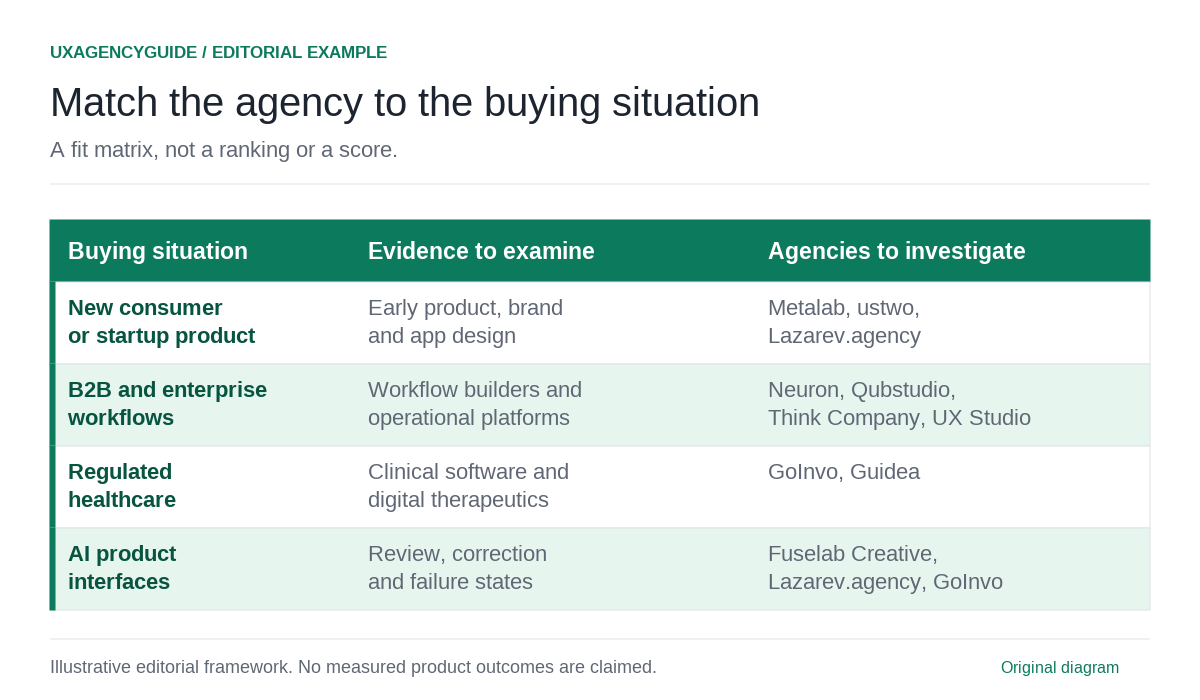
Use these groupings to narrow the field, then read the profiles. An agency can appear under one situation here and still do excellent work elsewhere; the grouping reflects the evidence we reviewed, not the limits of the firm.
| Buying situation | Agencies worth investigating | Evidence to examine | Question to ask first |
|---|---|---|---|
| New consumer or startup product | Metalab, ustwo, Lazarev.agency | Early-stage product, brand and app design | Will the same team handle brand, product and engineering? |
| Commerce and brand-led digital products | Work & Co | Ecommerce strategy and detailed design | Who builds and maintains the platform after launch? |
| B2B SaaS and enterprise workflows | Neuron, Qubstudio, Think Company, UX Studio | Workflow builders, operational platforms, design systems | How will existing users keep working during the change? |
| Data-heavy and technical interfaces | Fuselab Creative, Fuzzy Math | Machine-learning tools, security dashboards | Who owns the data model and the implementation? |
| Regulated healthcare | GoInvo, Guidea | Clinical software, digital therapeutics | What regulatory evidence will the design work need to support? |
| AI product interfaces | Fuselab Creative, Lazarev.agency, GoInvo | Conversational and agentic product work | How does the design handle uncertain or wrong outputs? |
If your situation is narrower, the specialist guides go further: startup agencies, SaaS agencies, AI interface agencies, dashboard design agencies and healthcare UX agencies.
Selection framework and evidence
We started from a pool of agencies with documented product design work and looked for one or more specific project pages per agency that a buyer could read and question. A page counted as evidence when it named the product type, described the users, and gave some account of the agency’s role. A homepage claim such as “award-winning” or a logo strip did not count on its own.
Four questions shaped each profile:
- What was the product and who used it? A dashboard for security engineers is different evidence from a dashboard for retail executives, even if the screens look similar.
- What did the agency say it did? Research, interaction design, visual design, design systems, engineering and strategy are separate contributions. Many case studies cover only some of them.
- Who else was involved? Several pages in this guide credit the client’s own developers with implementation. That is normal and useful to know, because it tells you what a similar engagement would leave to your team.
- What does the page claim as a result, and on whose authority? Where a case reports a number, we attribute it to the agency or the client. A case study is the agency’s account of its own work, not an independent measurement.
We did not assign scores. Numeric ratings across agencies would imply a common test that did not take place. Instead, the profiles describe evidence and limits so you can apply your own criteria. The Nielsen Norman Group article library is a useful independent reference if you want shared vocabulary for research methods and usability evaluation before talking to agencies.
Agency profiles
The profiles are grouped loosely by the situations above. Order within the list is not a ranking.
At a glance
The table compares all twelve agencies on the same terms. The profiles below explain each project and what to ask.
| Agency | Named project | Documented role | Suits this engagement | Published price or terms (20 Nov 2026) | Main limitation |
|---|---|---|---|---|---|
| Metalab | Slack (archived) | Product, brand, mobile app and marketing site | Early product needing brand and interface together | Not published | Historical case; current team may differ |
| ustwo | Mavie | Strategy, iOS design, architecture, design system | Consumer products built on trust | Not published; Discover from 8 weeks | Award is recognition, not outcome data |
| Lazarev.agency | Elva | End-to-end design of an AI video editor | AI-led consumer apps | Not published | No product metrics published |
| Work & Co | Canada Goose | Product strategy, concepting and detailed design | Commerce and brand-led platforms | Not published | Build partner not stated |
| Neuron | Vendr | Embedded design partner; client’s developers built it | Complex B2B configuration and approvals | Lowest contact-form budget band: under $25,000 | First engagement four months; results not measured |
| Qubstudio | Deaglo | Research, IA, testing, design system over nine months | Revamping data-heavy platforms | Not published | Component count is not an outcome |
| Think Company | Global media and technology company | Embedded cross-discipline teams | Changing how large internal teams work | Vision Sprint about $50K; free half-day workshop | Client not named |
| UX Studio | Oversee.ai | One designer and one researcher for a year | Research-led SaaS from proof of concept | Not published; free 5-day trial | Small team; confirm capacity |
| Fuselab Creative | Grid.ai (Lightning AI) | UI/UX and design system; client built it | Technical and data-heavy products | $100 to $150 per hour; engagements from $25,000 | Design only on this project |
| Fuzzy Math | Data security platform | Design team with the client’s developers | Enterprise products with several user types | Not published; one-week starter engagements | 20% engagement rise is agency-reported |
| GoInvo | CodeRyte | Design strategy and interface engineering, staged prototypes | Clinical and enterprise health software | Design Diagnostic $50K to $90K; Product Launch $75K to $250K | Efficiency gain is the hospital’s estimate |
| Guidea | Digital health portfolio | Research and design for regulated health software | Digital therapeutics and medical devices | Not published | Portfolio-wide figures; some projects under NDA |
Published terms are what each agency’s own website showed on 20 November 2026 (see our hiring benchmark); “not published” means we did not find a price, not that none exists. Roles and limitations are our reading of the cited project page.
Metalab: early-stage product, brand and build
Metalab’s archived Slack case describes a historical engagement that began from an early, unstyled prototype and covered the product, brand, mobile app and marketing site. Its current portfolio presents work from startups to Fortune 500 companies and marks archived cases clearly, with some recent projects listed as full builds that include engineering.
The useful signal is breadth: a team that can take a product from rough concept to a coherent brand and interface. The limit is that a famous historical project says little about today’s team, availability or price. Ask to see a recent comparable engagement and confirm whether engineering is included or handed to your developers.
ustwo: consumer product with deliberate restraint
ustwo’s Mavie case describes strategy, iOS design, privacy-first architecture and a design system for a wellness app for mothers, co-developed with a physician founder. The agency says the app deliberately avoids streaks, completion pressure and performance-based tracking, which is a clear product decision rather than a visual one.
This is relevant if your product depends on trust and tone as much as on features. The page reports an Apple “Best New App” listing; treat that as recognition, not as proof of health outcomes. Ask how the team made and tested the decision to remove common engagement mechanics.
Lazarev.agency: AI-led consumer apps
Lazarev.agency’s Elva case describes end-to-end design of a voice-first AI video editor: brand, onboarding, the voice flow, camera coaching and monetization. It describes draft-and-approve steps and clarifying questions, so the user reviews what the AI produces before accepting it, and an upgrade screen that shows free alternatives instead of a blocking paywall.
The page reports design awards and lists growth and retention tags without figures. That makes it good evidence of interaction approach and weaker evidence of commercial results. Ask for the product metrics the team tracked after launch and who owned them.
Work & Co: commerce and brand-led platforms
Work & Co’s Canada Goose announcement states that the agency led product strategy, concepting and detailed design for a new ecommerce flagship built on a custom Shopify implementation. The page does not say who built the implementation, so a buyer should not assume development was part of the engagement.
Work & Co is worth investigating when commerce, brand storytelling and product detail need to work together. Confirm the build partner, the content model and who maintains the storefront after launch. Those questions decide most of the long-term cost of an ecommerce redesign.
Neuron: enterprise workflow products
Neuron’s Vendr case describes an embedded design partnership on a procurement platform: a human-in-the-loop workflow builder, an intake form builder, request tracking and task views for builder, requester and assignee roles. The agency handed designs to Vendr’s internal developers, and the first engagement took four months.
This is strong evidence for complex B2B configuration work, where the hard design problem is conditional logic and role-based responsibility. Ask how Neuron would structure an embedded engagement with your product managers, and what documentation your developers would receive.
Qubstudio: data-heavy operational platforms
Qubstudio’s Deaglo case describes nine months of work on an enterprise FX risk platform for bank sales representatives, managers and investors. The listed work covers research, information architecture, user interviews and testing, prototyping and a design system, on a time-and-materials model. The agency reports more than 700 components in the resulting design system.
The case is relevant for financial or operational software that is already in use and needs a structured revamp. Ask how the team prioritized features against the existing navigation, and how the design system is governed after the engagement ends.
Think Company: embedded teams for large organizations
Think Company’s global media and technology case describes unifying separate tools used by technicians, sales staff and support representatives into a single platform with a shared design system that the client’s team now owns. The agency describes an embedded team that grew from one tool into cross-discipline teams covering strategy, design, content and engineering. The client is not named.
This is the right kind of evidence if you need to change how a large internal team works, not just redesign screens. Ask how the agency transferred ownership of the design system and what governance remained with the client.
UX Studio: research-led SaaS from proof of concept
UX Studio’s Oversee.ai case describes a dashboard, anomaly-detection page, design system and website for a SaaS platform that monitors insurers’ AI models. The agency says one designer and one researcher worked for a year with the client’s developers, starting from a proof of concept and an investor-ready MVP, with more than 20 stakeholder interviews.
That gives a buyer a concrete view of team size and pace. Ask how research findings were recorded and reused, and how decisions were shared with the client’s developers between releases.
Fuselab Creative: technical and data-heavy interfaces
Fuselab Creative’s Grid.ai case describes UI/UX and a full design system for two machine-learning products, experiment tracking and workflow automation, and credits Lightning AI’s internal team with development. The agency says both products are live. Its AI design practice page states that healthcare makes up more than half of its portfolio and publishes rates of $100 to $150 per hour, with engagements from $25,000.
Published pricing is unusual and useful for planning, though it is a starting point rather than a quote. Fuselab is worth investigating for technical tools, AI interfaces and health data products. Confirm whether design-only work or design with API and engineering support fits your team.
Fuzzy Math: enterprise security and analytics
Fuzzy Math’s data security platform case describes modernizing a legacy vulnerability-scanning product, with a customizable dashboard based on role permissions, a widget toolbox for administrators and a preview mode. The agency describes itself as the design team working with the client’s developers on implementation, and reports a 20% increase in user engagement in the six months after launch.
The case shows how a design team handles several user types (security officers, engineers, executives and administrators) in one product. Ask how engagement was measured, and what the agency would need from your analytics team to report results the same way.
GoInvo: clinical and enterprise healthcare software
GoInvo’s CodeRyte case describes NLP-backed software for hospital medical coders, developed through an 8-week proof of concept, a 12-week working prototype and more than 15 prototypes, with a daily feedback loop from a 12-hospital customer. The agency staffed it with two designers and one engineer over 15 months and describes its role as design strategy plus interface engineering. The page attributes a 200% coding efficiency increase to the hospital’s own conservative estimate.
The staged approach is the most transferable lesson. Ask how GoInvo decides when a prototype has answered its question, and how it handles HIPAA and legacy-system constraints during design.
Guidea: digital therapeutics and regulated health products
Guidea’s digital health page describes research and design for software as a medical device and digital therapeutics, lists FDA-cleared digital therapeutics among its projects and reports 22 FDA clearances across its work. Some projects are listed as under NDA.
For a regulated product, that domain record matters more than visual portfolio quality. The figures are agency-reported, so ask which clearances the agency’s own work supported and what part of the evidence package its research produced.
Specialist versus general fit
A general product studio and a domain specialist solve different risks. The generalist reduces the risk of a weak product experience: unclear flows, inconsistent visual language, a brand that does not carry into the interface. The specialist reduces the risk of designing something the domain will reject: a clinical tool that does not fit regulated workflows, or an AI feature with no answer for wrong outputs.
Choose a specialist when the domain changes the design problem itself. Healthcare is the clearest example, because research participants, regulatory evidence and clinical safety shape every decision. AI behavior is another, because the interface has to handle uncertainty, review and correction. Dense operational data is a third.
Choose a broad studio when the main challenge is creating a coherent product quickly, especially for a new consumer or SaaS product. Several studios in this guide also have domain depth, so the distinction is about the evidence you ask for, not a fixed label. A studio with a strong general portfolio should still be able to show one project close to your domain, and a specialist should still be able to show strong interface craft.
Engagement models and scope
The case studies in this guide show four common models. Naming them helps you compare proposals that would otherwise look incomparable. For the broader choice between an agency, a freelancer and an in-house team, see our agency vs. freelancer vs. in-house comparison.
| Model | Example in this guide | What your team keeps | Watch for |
|---|---|---|---|
| Design handed to your developers | Grid.ai, Vendr | Engineering and release decisions | Quality of specifications and state coverage |
| Embedded team inside your organization | Think Company, Neuron | Product ownership and roadmap | Clear decision rights and knowledge transfer |
| Staged discovery, prototype and build | GoInvo CodeRyte, UX Studio Oversee.ai | Business decisions at each stage gate | An explicit stopping point after each stage |
| Design with a separate build partner | Work & Co Canada Goose | Coordination between suppliers | Who resolves conflicts between design and build |
Pricing is rarely published; in our UX agency hiring benchmark, only 7 of 21 agencies published figures. Fuselab’s published rates are one data point; other agencies in the pool publish fixed tiers for specific services such as audits and prototypes, described in our UX audit guide and prototype comparison. For most agencies you will need a scoped conversation. Ask for estimates structured by phase so you can stop or change direction without renegotiating everything.
Ask also about the team. Several cases name small teams (one designer and one researcher, or two designers and one engineer). Smaller teams can move quickly but carry key-person risk. Confirm who will actually work on your project and what happens if someone leaves.
How to make a shortlist
A practical shortlist has three to five agencies. More than that and you will not have time to compare them properly; fewer and you may not see a real range of approaches.
- Write a one-page brief. State the product, users, the decision the work should inform, known constraints and whether engineering is in scope. Our UX design brief template gives a structure, with sections for users, scope, constraints and deliverables.
- Pick agencies from the matching buying situation. Use the table above, then add one agency from a neighboring situation to test your assumptions.
- Request one comparable case and a walkthrough. Ask the person who did the work to explain one hard decision: what they considered, what they rejected and why.
- Give every agency the same scenario. For example: “A new administrator invites three colleagues with different permissions. One invitation fails.” Compare how each agency would research, design and hand off that flow.
- Score against your own criteria. An agency evaluation scorecard keeps the comparison consistent and records unknowns instead of hiding them.
- Check references for the specific team. Ask a past client about communication, handling of scope changes and the quality of the handoff, rather than general satisfaction.
Red flags during selection
Treat these as reasons to ask more questions, not automatic disqualifications. A proposal that promises outcomes such as conversion or revenue growth without discussing how they will be measured. A portfolio that shows only final screens with no account of research or decisions. A team that cannot say who did the work on the case they are presenting. A price that arrives before any discussion of scope. Each of these suggests the agency is selling a result rather than explaining a process you can evaluate.
Keep the decision record
Once you choose, write down why: the evidence that convinced you, the risks you accepted and what you will check after the first month. That record makes the first review conversation more productive, and it helps the next hiring decision start from evidence rather than memory.
Frequently asked questions
Is there a single best UX design agency?
No single agency suits every product. The strongest choice is the one whose documented work matches your product type, the decision you need to make next and the scope you expect, such as research, interface design, engineering or a combination. Compare agencies against those conditions rather than against general reputation.
Should I hire a specialist agency or a generalist?
Choose a specialist when the domain changes the design problem, for example regulated healthcare, AI behavior or dense operational data. A broad product studio can suit a new consumer or SaaS product where speed, brand and interface quality matter more than domain constraints. Ask either type for a comparable project and the team that did it.
What should a UX agency proposal include?
A useful proposal states the problem, the users involved, the research planned, the deliverables, who owns engineering, how decisions are reviewed and what happens at handoff. It should also list assumptions and exclusions. Compare proposals through the same scenario so differences in scope are visible.
How much do UX design agencies cost?
Few agencies publish prices, and published figures are starting points rather than project totals. One agency in this guide publishes hourly rates of $100 to $150 with a $25,000 starting engagement, and others publish fixed audit or prototype tiers. Scope, team size, research recruitment and engineering responsibility change the total more than the agency’s name.
Sources & evidence
- Grid.ai / Lightning AI machine learning dashboard designChecked 2026-11-20
- AI product design agency for regulated and enterprise AIChecked 2026-11-20
- Slack product design case studyChecked 2026-11-20
- Our workChecked 2026-11-20
- Canada Goose launches new digital flagshipChecked 2026-11-20
- Mavie x ustwoChecked 2026-11-20
- Oversee.ai case studyChecked 2026-11-20
- Deaglo FX risk management platformChecked 2026-11-20
- Global media and tech companyChecked 2026-11-20
- Data security and risk management platformChecked 2026-11-20
- Vendr case studyChecked 2026-11-20
- Digital health product designChecked 2026-11-20
- Natural language processing software for hospital codingChecked 2026-11-20
- Elva voice AI video editor app designChecked 2026-11-20
- Nielsen Norman Group articlesChecked 2026-11-20
Specific sources, useful examples and clear limitations make advice easier to assess.
Read the editorial policy